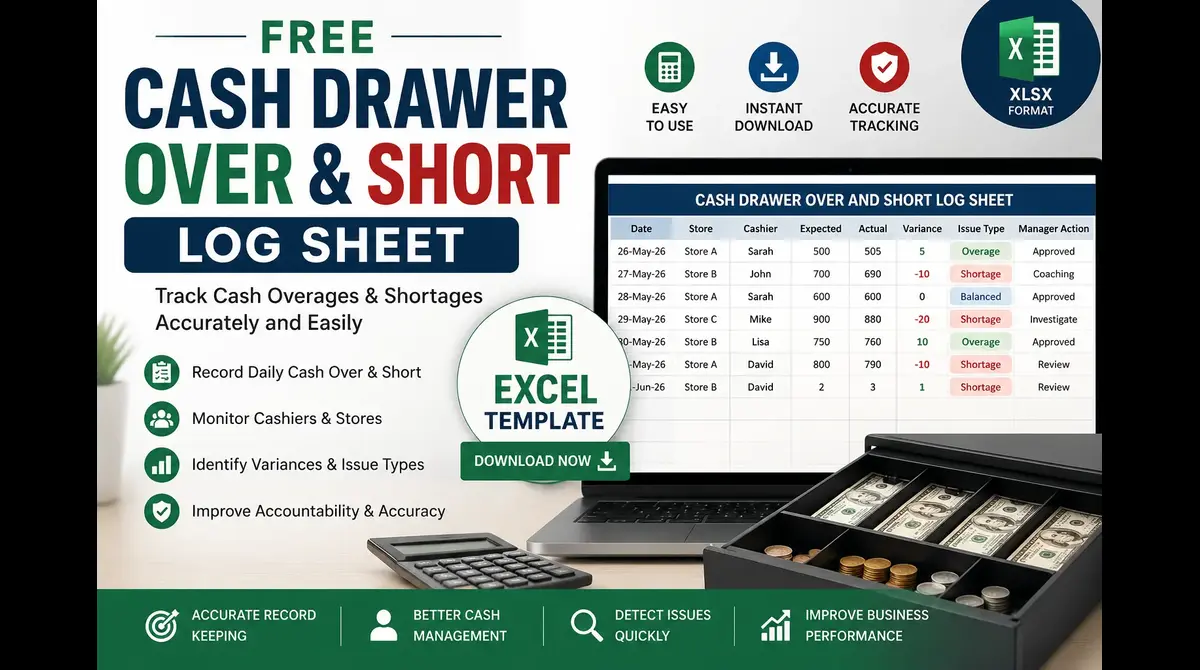
End-of-shift cash reconciliation is one of those retail tasks everyone agrees is important—yet many teams still do it in a “hit-and-miss” way. That’s where a cash drawer over-and-short log sheet comes in handy.
Think of it as a simple record that answers three questions fast:
- What did the POS system expect?
- What did the cashier actually count?
- If there’s a difference, what was the cause, and what action was taken?
When you consistently capture that, cash control becomes easier, investigations become faster, and coaching becomes fairer.
What is a Cash Drawer Over and Short Log Sheet?
A cash drawer over and short log sheet is a reconciliation log that compares:
- Expected cash (usually from POS system totals)
- Actual cash (physical count in the drawer)
It then records the difference as:
- Overage (Actual is higher than Expected)
- Shortage (Actual is lower than Expected)
- Balanced (No difference)
Your log should also include a reason/notes and manager action—because the “why” and the “what next” are what turn the numbers into a usable process.
Why Retail Teams Use It (Not Just Paperwork)
In retail, cash differences can occur for normal reasons—rush-hour change issues, discounts/refunds, counting errors, or POS closing timing. But without a log sheet, those issues become:
- harder to explain during review
- impossible to track over time
- unfair when coaching is based on assumptions
With a log sheet:
- Discrepancies are documented
- Repeat patterns are easier to spot
- audit trail becomes stronger
- Decisions are based on recorded facts
What Your Template Should Capture (Excel-Friendly Columns)
A clean structure usually includes fields like your setup:
- Date
- Store
- Cashier
- Expected (POS)
- Actual (counted)
- Variance (Actual − Expected)
- Issue Type (Overage / Shortage / Balanced)
- Reason / Notes
- Manager Action (Approved / Coaching / Investigate / Review)
This format is ideal because it supports both day-to-day reconciliation and bigger reporting (dashboards, store ranking, and cashier analytics).
How to Fill It In (Quick Workflow)
1) Close the POS shift
Confirm the Expected cash amount for the drawer/cashier session.
2) Count the drawer cash carefully
Bills + coins = Actual.
3) Calculate variance
Variance = Actual − Expected
4) Select Issue Type
- Variance > 0 → Overage
- Variance < 0 → Shortage
- Variance = 0 → Balanced
5) Write a short reason (important)
Keep it practical. For example:
- “Change error during rush”
- “Refund/discount adjustment not matching expected.”
- “Counting mismatch—bills miscounted”
6) Record manager action
Examples based on common review outcomes:
- Approved
- Coaching
- Investigate
- Review (especially for extreme variances)
Different Users, Different Focus
If you’re a Cashier
Your goal is simple: enter the numbers correctly, add a clear short note, and submit for review. A good log helps you because your manager can verify with evidence—not guesses.
If you’re a Store/Restaurant Manager or Cashier Supervisor
Your job is to reduce repeat issues. The log sheet helps you:
- spot recurring over/short patterns
- Enforce a consistent end-of-shift process
- ensure each discrepancy has an action trail
If you’re a Small Business Owner
You want fewer surprises. This log sheet acts like a safety net:
- You can see where variances happen most
- You can justify actions and follow-ups
- You reduce “loss through silence” (issues that never get tracked)
If you’re a Bookkeeping Staff / Back-Office
Your focus is accuracy and documentation:
- The log provides a reconciliation trail
- Manager actions and reasons support internal controls
- It helps when you need to review discrepancies later.
Recommended Download: Use an Excel Template (Best for Retail)
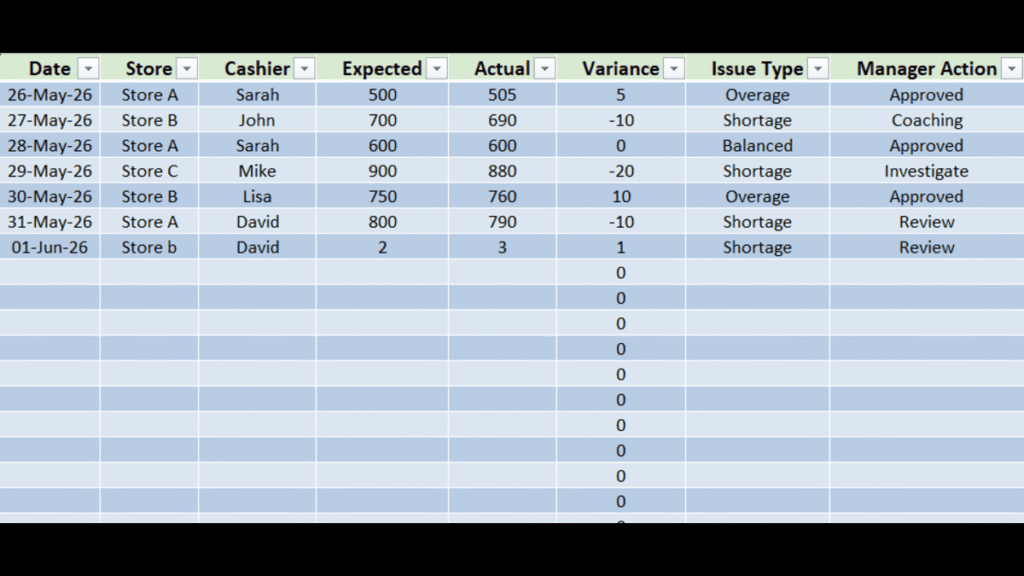
Why it’s recommended:
- It uses a consistent format for Expected vs Actual
- Variance and issue type are aligned with the reconciliation process
- Dashboards can summarize totals, store rankings, and cashier error frequency
- It keeps manager action documented in one place
Suggested usage: enter daily entries in the Transactions area, then review summaries on the dashboard sheets.
Best Practices Checklist (So Your Log Stays Useful)
- Always use the same cash-counting method
- Always record a reason for variances (even a short one)
- Don’t ignore repeated shortages—review patterns by store/cashier
- Treat extreme variance entries as “investigate first.”
- Keep manager action consistent (approved/coaching/investigate/review)
Conclusion
A cash drawer over-and-short log sheet is one of the easiest ways to improve cash control in retail. It’s not complicated, but it makes a big difference because it captures the full story: Expected vs Actual, the variance, the reason, and the action taken.