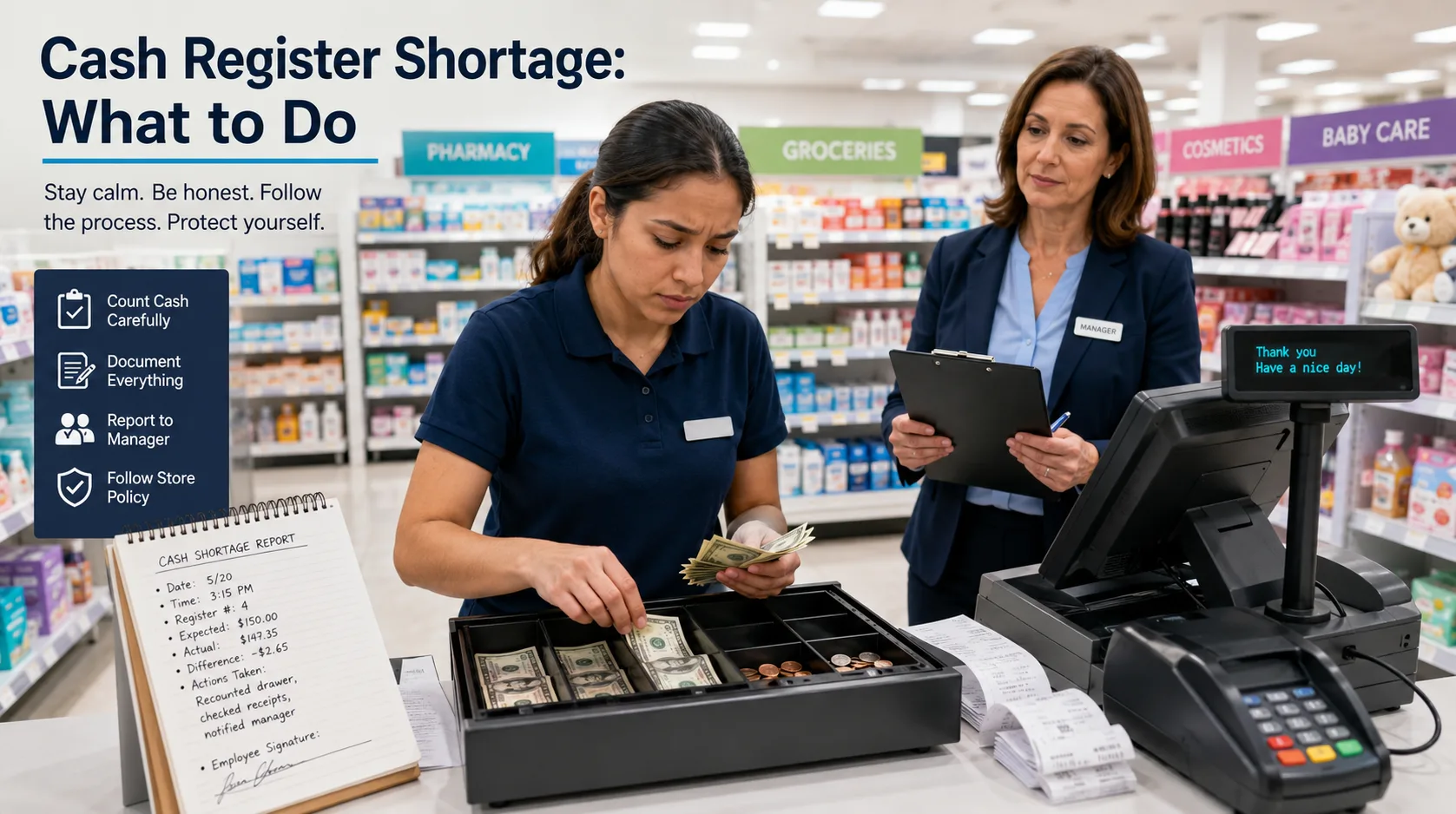
Key Takeaways
- Most cash register shortages come from human error, not theft
- Always investigate before assuming the worst
- Write down every finding, including amounts, possible causes, and what you checked.
- Report to your manager or supervisor immediately and honestly
- A minor variance of less than $2 during high-volume shifts is typically considered acceptable under standard cash-handling procedures.
- Never adjust cash or records without management approval
Why This Happens More Than You Think
Cash shortages happen in nearly every retail environment. It does not matter how careful your team is or how good your POS system is.
At the department store where I work, we sell both drugs and other items. These include groceries, cosmetics, and baby care. We follow strict procedures, but we still see mistakes a few times each month.
Our store makes over $3,000 in sales each day. A difference of $2 or $3 at closing is considered normal, since it is less than a 0.1% variance. But if the difference is higher, we investigate it that same night before anyone leaves.
The goal of this article is simple: to help you figure out what went wrong, explain it clearly, and talk to management without making it a bigger issue than necessary.
The Most Common Reasons Cash Goes Missing
Before you can explain a shortage, you need to know what really causes it. Here are the actual reasons, not just the textbook examples.
Reason-1: Counting errors during busy periods
This is probably the number one cause. When the counter is crowded and 10 to 12 customers are waiting, a cashier can easily accept $40 instead of $50 without realizing it.
The customer moves on, the next person steps up, and no one notices until closing.
Reason-2: Rounding discounts given to customers
One thing I’ve noticed in day-to-day operations is how quickly small rounding adjustments add up.
At our store, we allow cashiers to waive up to $0.10 when a customer is a few cents short.
That feels like nothing per transaction. But over a full 14-hour operating day with hundreds of transactions, it can add up to a dollar or two by midnight.
Reason-3: Petty cash entries are recorded late or incorrectly
This one can cause big problems. If a store expense is paid from the till during the day but not recorded in the ledger right away, it can appear as missing money at closing.
We had a situation where a $100 expense was logged, but the entry was incomplete.
It took over an hour to trace. Since then, every single expense gets entered the moment cash leaves the drawer — not at the end of the shift.
Reason-4: POS settlement receipt printed too early
This caused our biggest apparent shortage ever. Someone printed the bank terminal’s settlement receipt before the last few card transactions had cleared.
The receipt showed a lower total than what was actually collected. We recounted the cash twice, went through the ledger line by line, and still could not find the explanation.
Then we found the timing issue. Once we had the correct final settlement receipt, everything matched. Now, we have a strict rule: only print the POS settlement after the last customer has paid.
Reason-5: Counterfeit notes
During a rush, there is no time to run every bill through the counterfeit detection machine. A fake $50 or $100 bill can slip through. At midnight, when you count carefully, the paper feels off. Held to a light, there is no watermark, no security thread.
At that point, the money is gone, and there is nothing you can do to recover it. The shortage is recorded and reported. No one is personally blamed, but it is documented.
Reason-6: Incorrect change given
A cashier gave $20 change when the correct amount was $10. The customer walks out happy. The register ends up $10 short. This is more common than people admit.
Reason-7: Refunds or voids processed incorrectly
A refund entered incorrectly, or a voided transaction that does not get properly removed from the count, can create a discrepancy that looks mysterious until you trace the transaction log.
Step-by-Step: How to Handle a Cash Register Shortage
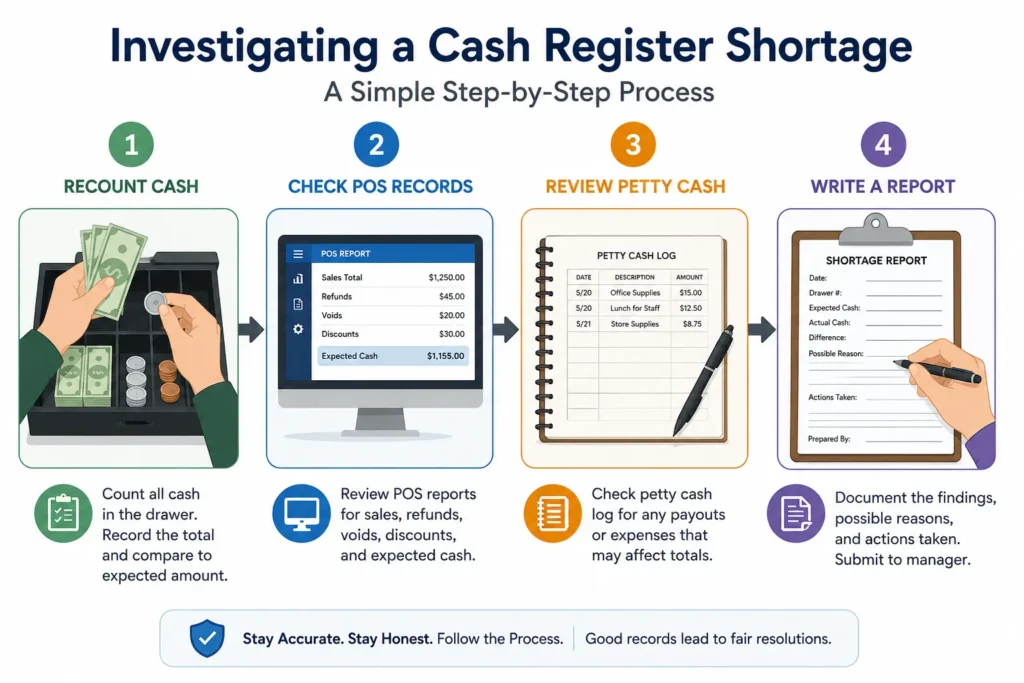
Step 1: Do not panic and do not assume theft
The first instinct when cash is short is to assume someone stole it. That is rarely the case. The far more common explanation is a process error somewhere in the day. Start there.
Step 2: Recount the cash carefully
Separate every bill and coin by denomination. Count each pile on its own. Add everything up again from the beginning. Counting errors can happen during a busy shift, even for experienced cashiers. You might find the shortage goes away when you recount calmly.
Step 3: Pull the POS records
Check the transaction log on your point-of-sale system. Look for any voided transactions, refunds, or unusual entries. Compare the total card payments recorded in the POS with the actual settlement receipt from each bank terminal. Make sure the settlement receipt was printed at the right time, after all transactions were finished.
Step 4: Review the petty cash ledger
Go through every expense logged during the day. Check that each entry has a complete amount recorded. One incomplete entry can throw off your entire closing figure.
Step 5: Check your receipts and transaction records
Cross-reference sales receipts against the register total. Look for any transaction in which the change given might have been incorrect. If you have a cash-counting discrepancy, the paper trail usually reveals it.
Step 6: Document what you find
Write down the shortage amount, the possible causes you identified, what you investigated, and what you could or could not explain. This documentation matters when you speak to your manager.
Step 7: Report it honestly before the shift ends
Do not close the register and leave without telling anyone. Report the shortage to your manager or shift supervisor that night, before you go home. Bring your documentation. Walk them through what you found.
How to Actually Explain It to Your Manager
The conversation does not have to be awkward. Here is what works:
Be direct first. Something like: “We have a $15 shortage tonight. I’ve gone through the count twice, checked the POS records, and reviewed the petty cash ledger. Here’s what I found.”
Then walk through the possible causes. Did you have a busy evening where counting errors were likely?
Did anyone give a refund or process a void? Were there petty cash expenses?
Did the POS settlement get printed at the right time?
If you can explain the shortage, even partly, it shows you investigated properly and take cash accountability seriously.
If you truly cannot explain the shortage, say so honestly. Reporting an unexplained shortage right away is much better than having it discovered later because you tried to hide it.
In practical experience, managers respond much better to honest reports than to problems discovered on their own.
One thing I’ve noticed is that the staff who build the most trust with management are the ones who bring bad news early, with the facts in hand.
What Good Documentation Looks Like
When you report a cash shortage, having it written down makes the conversation easier and protects you. A basic shortage report should include:
- The date and shift
- The total sales figure from the software
- Your actual cash count (broken down by denomination if possible)
- Card payment totals from POS settlement receipts
- Total petty cash expenses from the ledger
- The shortage amount
- Possible causes identified during your investigation
- Any transactions you flagged as potential errors
Ask a supervisor or HR if unsure about documentation requirements. This empowers cashiers to follow the correct process and avoid mistakes.
Expert Tips for Preventing Future Shortages
- Count back change out loud: When giving change, count it back to the customer verbally. This catches errors before the customer walks away.
- Log petty cash immediately: The moment cash leaves the drawer for any store expense, it goes in the ledger. Not later. Right now.
- Print the POS settlement only after the last transaction: This rule cannot be skipped. Printing the settlement too early will always cause a discrepancy.
- Do a quick note check during busy periods: Even without a detection machine, rubbing a large bill and briefly holding it toward a light takes three seconds and catches most counterfeits. Look for the texture and the watermark.
- Do not rush the closing count: Give the cash reconciliation the time it needs. A closing process completed in five minutes when it should take twenty-five is done wrong.
Common Mistakes to Avoid
Cash Register Shortages: Does the Cashier Have to Pay It Back?
This depends on the employer and the country. At the store where I work, staff are not required to cover cash shortages from their own wages.
The focus is on identifying the process error and fixing it. The owner might express disappointment, but no one is docking anyone’s paycheck.
If you’re unsure about your store’s policy, ask your supervisor or HR.” This makes the advice clearer and more actionable.
No matter the policy, if theft is confirmed through investigation and evidence, not just assumption, it is handled separately and usually leads to termination.
FAQ
What if the register is over instead of short?
What’s an acceptable cash variance?
Can I be fired for a single cash shortage?
What if I suspect a colleague took money from the till?
Should I ever not report a small shortage?
Final Verdict
A cash register shortage can feel stressful at the time. But most of the time, it is caused by a counting mistake, a timing issue, a missing ledger entry, or a fake bill during a busy night—not theft, not negligence, and not a crisis.
Handle it the right way: investigate carefully, write down what you find, and report it honestly to your manager before you leave. This approach protects you, builds trust, and actually solves the problem.
In many stores, the cashiers with the cleanest records are not the ones who never run short. They are the ones who handle shortages with transparency every single time.