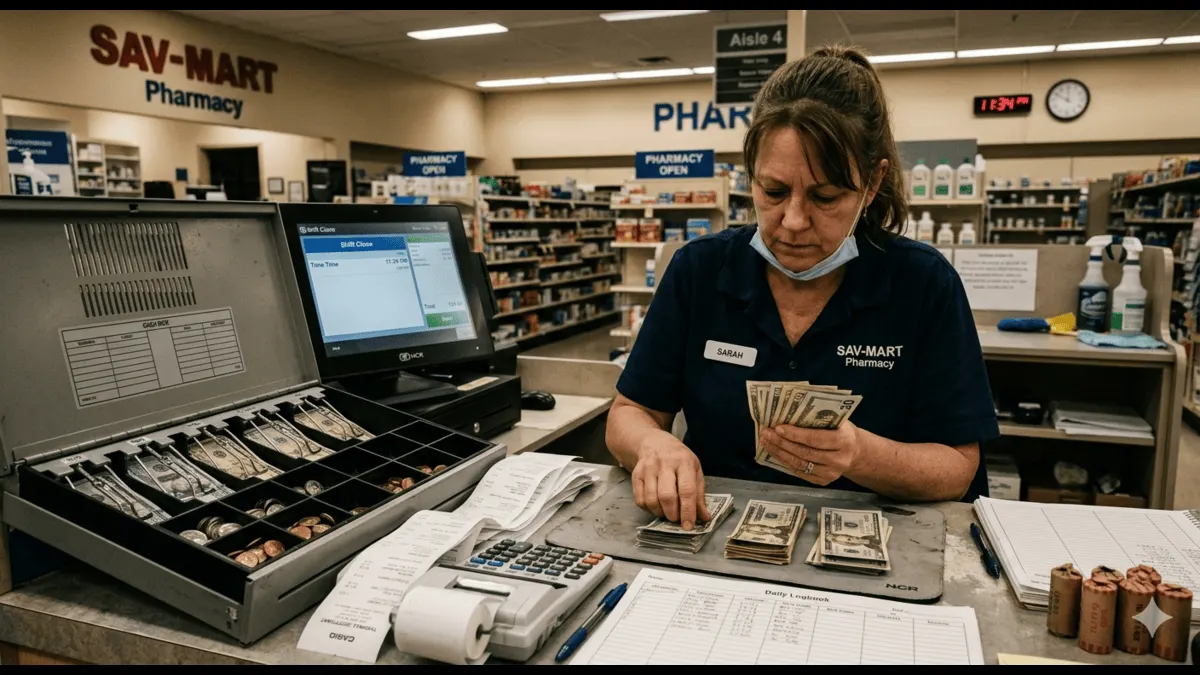
If you’re searching How to Balance a Cash Drawer at Closing Without Shortages, you usually want two things:
- A reliable cash counting process (so your till balancing is accurate), and
- A clear way to handle cash reconciliation when there’s a cash shortage or cash overage.
In retail, cash drawer balancing isn’t just “count and write.” Your result depends on timing, POS proof, and petty cash handling.
2. Collect final POS settlement receipts from all relevant POS terminals
3. Add petty cash expenses from your separate petty cash ledger
4. Reconcile against combined Net Pharma + Net Non Pharma (net sales total)
5. If mismatch happens, investigate in this order:
Recount → POS receipt timing/terminals → petty cash ledger → daily event review
Step-by-Step: End-of-Shift Cash Counting
Step 1: Do it after shop close and shift closing procedure
In my store, the shop closes at midnight, and we follow our shift closing procedure first.
This matters because if you count cash while payments are still coming in, your POS report and your cash register balancing won’t describe the same moment.
Step 2: Count bills and coins separately
I count:
- Notes by denomination
- Noins by coin value/type
I keep them separated as I count, then total them at the end. This is simple, but it helps when you later need to find where a mistake happened.
Step 3: Collect final POS settlement receipts from all relevant terminals
Our store uses 5 POS terminals. The reason is practical: not every terminal supports every bank card connection.
So at closing time, I collect the final POS settlement receipt per relevant terminal/bank coverage.
Rule we follow (this is important):
We print settlement receipts after the last customer payment and after shop close.
Step 4: Add petty cash from a separate petty cash ledger
In my store, petty cash expenses are tracked in a separate petty cash ledger.
During end-of-day reconciliation, I total the petty cash expenses from the ledger and include them in the reconciliation.
This is a prime example of how retail accounting connects directly with daily store operations.
You Can Read more: How Retail Store Accounting Works in Real Daily Operations.
Step 5: Reconcile using combined Net Pharma + Net Non Pharma total
In our POS software, we can view:
- Net Pharma Sale
- Net Non Pharma Sale
But for cash drawer balancing, we reconcile using the combined total: Net Sales Total = Net Pharma + Net Non Pharma (combined)
Returns/refunds/void logic is handled separately inside POS software and reflected in the final net reports.
So we don’t manually subtract returns during cash reconciliation.
My reconciliation equation (daily cash reconciliation):
Cash Drawer Total (bills + coins) + Total card payments (from final POS settlement receipts across terminals) = Net Sales Total (Net Pharma + Net Non Pharma combined) + Petty cash expenses
If it matches, the cash drawer is balanced. If it doesn’t match, we investigate.
Why you can trust the workflow?
I work as an accountant in a departmental store for 2 years.
My shift is 2 PM to midnight. After my accounting work finishes (around 10 PM), I help customers on the shop floor too.
That day-to-day exposure helps me understand how mistakes happen during real retail pressure.
Practical store data from my routine
- We use 5 POS terminals for bank card coverage
- Our reconciliation uses final POS settlement receipts printed after shop close
- We treat small variances (around $1–$2) as normal range, roughly < 0.1% variance
- We aim to keep shortage incidents around 4–5 times/month max
The strongest “proof” lesson I learned
The biggest mismatch we ever faced happened because a POS settlement receipt was printed too early—before all final card transactions were fully processed.
After we used the correct final receipt, numbers matched. That’s why my method prioritizes timing and terminal coverage.
Related Concepts You Actually Need
What is cash drawer in retail?
A cash drawer is the physical till containing bills and coins that should reconcile with sales records.
What is cash reconciliation?
Cash reconciliation is the process of matching:
- physical cash (drawer)
- POS card totals (from POS report / settlement receipts)
- petty cash expenses (ledger) against your POS system’s final net sales figures.
What is “cash shortage” vs “cash overage”?
- Cash shortage: drawer is less than expected reconciliation total
- Cash overage: drawer is more than expected reconciliation total
What is a POS report / POS settlement receipt?
It’s your system’s end-of-cycle snapshot for credit card transactions. In multi-terminal stores, you need the receipts from the right terminals.
Where do Refunds / Returns fit?
In our POS, returns/refunds/void logic affects the net sales figures inside POS software. That’s why reconciliation uses the final net totals.
Common Cash Drawer Counting Mistake
- Counting before final POS settlement
- Forgetting petty cash
- Missing one POS terminal
- Mixing denominations
- Ignoring refunds timing
- Using non-final receipt
Use Cases / Scenarios
Scenario 1 (common): Cash drawer mismatch but cash is not actually missing
Cause: POS settlement receipt printed before the last card transactions were fully processed.
Effect: You think you have a cash shortage, but the POS snapshot was incomplete.
Fix: Use only the final settlement receipt printed after last customer payment at shop close.
Scenario 2 (multi-terminal): One terminal receipt doesn’t cover the whole day
Cause: Comparing cash drawer with only one POS terminal’s settlement receipt.
Effect: Card payment totals look incomplete.
Fix: Collect final POS settlement receipts across terminals and add card totals properly.
FAQ
1) What causes a cash drawer shortage?
2) When should I count the cash drawer at end of shift?
3) How do I reconcile a cash drawer using POS reports?
4) What is the correct order to investigate a mismatch?
5) Which POS report should I use for cash reconciliation?
6) Do I need to subtract refunds/returns manually during cash counting?
7) What if my register is over at the end of the shift?
8) How often should cash register balancing be done?
9) Can discounts/rounding cause a cash mismatch?
10) Why do I need POS settlement receipts from all terminals?
Article Summary
This guide explains how I count and reconcile a cash drawer at end of shift using my real retail accounting workflow:
- Count bills and coins separately by denomination/value
- Do it after shop close and shift closing procedure
- Collect final POS settlement receipts from all relevant POS terminals
- Add petty cash expenses from a separate petty cash ledger
- Reconcile using combined Net Pharma + Net Non Pharma totals
- If mismatch happens, investigate in this order:
recount → POS receipt timing/terminals → petty cash ledger → daily event review
Conclusion
In retail, end-of-shift cash counting is not just counting money. It’s cash reconciliation—and reconciliation only becomes reliable when your timing is correct, your POS proof is complete, and your petty cash is included.
From my experience, the biggest lesson is simple:
Final POS settlement receipt timing + all relevant POS terminals + accurate petty cash ledger makes cash register balancing faster and more confident.
If you want, tell me your website’s preferred format for the page (short/medium/long article). I can also produce a “Cashier Closing Checklist” version for a second page or an in-article box.